

After a fire, the flames get all the attention. Soot gets ignored, and that is a mistake. Soot from fire is one of the most persistent, most damaging, and most underestimated hazards left behind after any fire event, whether it is a small kitchen fire or a major structural loss. In our work buying fire damaged homes, we walk through properties where the fire was contained but the soot spread far beyond the origin room. It is always further than people expect, always more damaging than it looks, and almost always inadequately cleaned.
This guide covers what soot actually is, what it looks and smells like, why it is dangerous, and how to approach removing it correctly.
What Is Soot
Soot is the byproduct of incomplete combustion. When something burns and the fuel does not fully combust, the unburned carbon particles bond together and become airborne before settling on surfaces. Soot is considered a hazardous substance with carcinogenic properties, and its composition includes not just carbon particles but also polycyclic aromatic hydrocarbons and heavy metals like mercury, depending on what burned.
The primary organic components of soot comprise a class of compounds known as polycyclic aromatic hydrocarbons, commonly referred to as PAHs, which include many known carcinogens.
The chemical makeup of soot varies depending on what burned. Wood and paper produce a different soot profile than synthetic materials like plastics, foam furniture, electronics, and textiles. The more synthetic the material, the more chemically complex and hazardous the soot tends to be. A house fire almost always involves both, which means the soot left behind after a residential fire contains a mixture of carbon particles, heavy metals, and organic chemical compounds that do not belong in a living space.
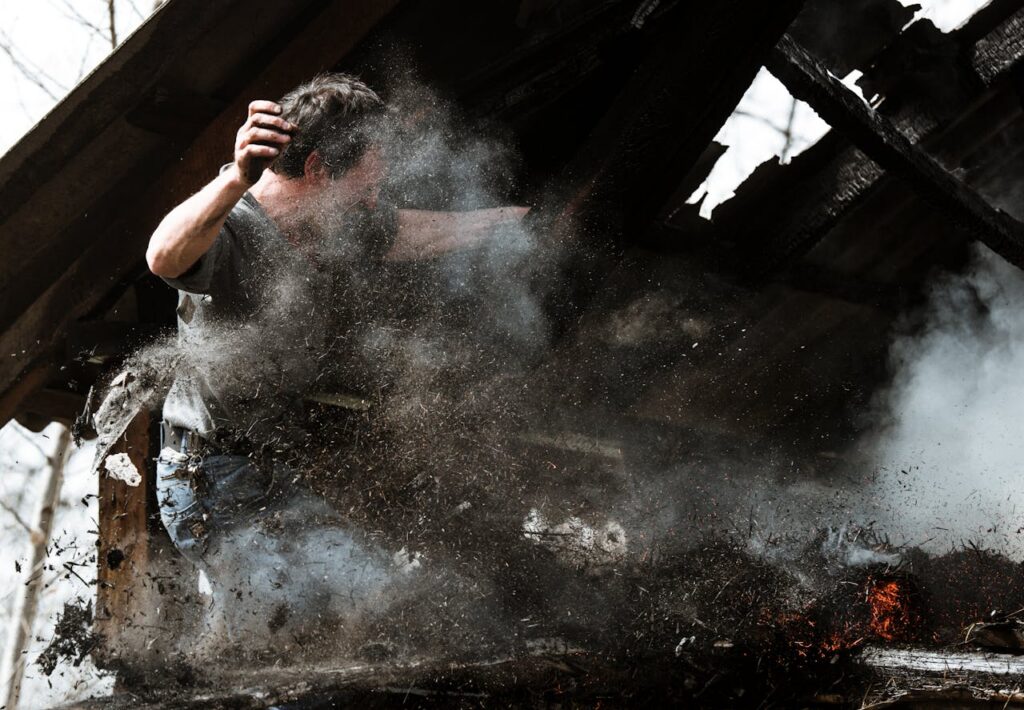
What Does Soot Look Like
Soot is not one uniform substance. Its appearance changes based on what burned and how hot the fire burned.
Dry Soot from Wood and Paper
This is the version most people picture, fine, powdery, and grey to black in color. It is produced by high heat fires burning natural materials like wood, paper, and cardboard. It looks like fine dust or ash and settles on horizontal surfaces. It is easier to clean than other types but deceptive, because it falls into cracks, crevices, and wall cavities where it continues to produce odor long after visible surfaces are cleaned.
Wet Soot from Synthetic Materials
Plastic and fabrics burn differently than natural materials. As they burn, they tend to create black smoke that rises quickly and clings to objects and walls, leaving behind a smudged, sticky residue. Do not touch this residue, it will stick to anything it comes in contact with.
This type of soot is dark, oily, and smears on contact. It is significantly harder to remove than dry soot and almost always requires professional treatment. If you try to wipe it with a damp cloth, you spread it further into the surface.
Protein Residue from Cooking Fires
Kitchen fires involving food produce a distinct type of residue. Fire uniquely affects proteins found in food, typically leaving behind a yellow-brown residue that looks like grease. It is nearly invisible on many surfaces but carries a persistent, foul odor that most homeowners describe as far worse than the smell of smoke itself.
Soot Staining on Walls and Ceilings
Regardless of type, soot staining on walls and ceilings follows a predictable pattern. The darkest concentration appears near the fire origin and along the ceiling, where heat and smoke traveled first. Lighter grey or yellowish discoloration extends outward from there, often reaching rooms that showed no other fire damage. Within hours, soot can discolor walls, pit chrome, and dull appliances. Glass, metal, and plastic all start to corrode. That faint yellowing you see on walls after a small fire is the acid from soot doing its work.
What Does Soot Smell Like
Soot has a distinctive, pungent odor often described as smoky or acrid. The intensity of the odor can vary depending on the materials burned. Burning plastic has a particularly strong smell.
Some people describe the smell of soot from a wood fire as similar to a campfire or charred wood. Soot from synthetic materials has a sharper, more chemical quality, closer to burning rubber or melted plastic. Protein soot from kitchen fires has a rancid, greasy quality that many find more unpleasant than any other type.
The odor compounds in soot are not just surface level. They bond chemically to porous materials, which is why soot smell persists in walls, carpeting, and furniture long after visible residue has been cleaned. A room can look clean and still smell strongly of smoke because the odor source is inside the wall cavity, the subfloor, or the HVAC ductwork rather than on any visible surface.
Is Soot Dangerous
Yes, and more so than most homeowners realize after a fire.
Respiratory and Health Effects
Hazardous chemicals produced when things burn include benzene, formaldehyde, and polycyclic aromatic hydrocarbons. These contaminants have been linked to cancer and other illnesses. The National Institutes of Health has documented the full spectrum of soot related health effects, finding that exposure to soot causes three main categories of disease, cancer, respiratory disease, and cardiovascular dysfunction, with PAHs identified as the primary carcinogenic compound.
Soot inhalation can irritate the eyes, nose, and throat and exacerbate respiratory conditions like COPD and asthma. It is also a known carcinogen. Children, elderly occupants, and anyone with existing respiratory conditions are at higher risk from soot exposure than healthy adults.
Carcinogenic Risk
Soot has long been known to cause cancer, with documented cases going back to chimney sweeps. More recently it has been found to increase cancer risk more broadly, specifically lung, bladder, and skin cancer. This is not a theoretical risk confined to industrial workers. Homeowners living in inadequately cleaned post-fire environments face meaningful ongoing exposure to the same compounds.
The CDC and NIOSH have published guidance on soot contamination risk specifically in the context of structural fires, noting that using detergent or soap has proved more effective than water alone at removing soot and contaminants such as PAHs.
Structural and Material Damage
Soot’s acidic properties can corrode metals, etch glass, and permanently discolor surfaces over time. The longer soot remains in contact with surfaces, the more irreversible the damage becomes. Surfaces that could have been cleaned within 48 hours of a fire may require replacement after a week or two of contact with acidic soot residue.
If soot gets into the ductwork, every time the HVAC system runs it spreads the residue again. That means more surfaces get coated and the air keeps circulating with microscopic debris. This is why turning off the HVAC system immediately after a fire is one of the most important steps in limiting soot spread.
How to Remove Soot from Fire
Protect Yourself First
Before touching anything, put on an N95 or higher respirator, nitrile gloves, and eye protection. Soot particles are small enough to pass through standard dust masks. Direct skin contact and inhalation should be avoided throughout any cleaning process.
Ventilate the Space
Open windows and set fans to exhaust air out of the property before beginning any cleaning. This reduces the concentration of airborne particles while you work.
Never Use Water on Dry Soot First
This is the most common mistake. Applying water or wet cleaning solution to dry soot turns it into a thick paste that embeds deeper into the surface. Always start dry.
Dry Soot from Hard Surfaces
Use a dry chemical sponge, sometimes called a dry cleaning sponge or soot sponge, to lift dry soot off walls and ceilings. Work from top to bottom in single strokes without rubbing. Rubbing spreads the soot laterally and pushes it deeper. Once the dry sponge pass is complete, follow with a TSP solution on hard surfaces that can tolerate it.
HEPA Vacuum Before Wet Cleaning
For floors, upholstery, and soft surfaces, use a HEPA filtered vacuum before any wet cleaning. Standard vacuums without HEPA filtration recirculate fine soot particles back into the air. HEPA filtration captures particles down to the size that soot occupies.
Wet Soot from Synthetic Materials
Wet, oily soot from synthetic materials requires professional treatment in most cases. Attempting to clean it without the right chemical agents typically results in spreading the contamination. Dry chem sponges followed by professional grade degreasers are the standard approach, but the surface type determines the specific method.
Sealing Before Repainting
Any wall or ceiling that has been cleaned of soot must be primed with a shellac based primer before any paint is applied. Standard paint does not seal soot odor. Without a proper soot sealing primer, the odor will bleed through finished surfaces weeks or months after painting. Kilz Original and Zinsser BIN are the industry standard products for this application.
When to Call a Professional
Professional remediation is the right call when the fire affected more than one room, when wet or synthetic soot is present, when HVAC contamination is suspected, or when soot is visible on ceilings throughout the home. The EPA has published guidance on indoor air quality after fire events that makes clear the health case for thorough professional remediation rather than surface level cleaning.
Soot and the Decision to Sell or Restore
In our experience, soot damage is one of the most underestimated factors in a post-fire restoration budget. What looks like surface discoloration is often structural penetration. What smells like smoke on the first visit returns after repainting if the underlying surfaces were not properly treated.
If you are working through what comes next after a fire that left significant soot contamination, the restoration process and what it costs gives you a realistic picture of what thorough remediation actually involves. And if you are at the point where the restoration cost outweighs the value of the outcome, selling the property as-is is a straightforward alternative that removes the remediation problem from your plate entirely.
We buy fire damaged homes in any condition, soot and all, for cash with no repairs required. Get a free cash offer with no obligation if you want to know what that number looks like before committing to a remediation budget.
Final Thoughts
Soot from fire is not just a cosmetic problem. It is a chemical hazard, a structural threat, and a persistent odor source that does not resolve on its own. Understanding what it looks like, where it travels, and why it requires proper treatment rather than surface cleaning is the starting point for any effective post-fire response.
Maybe you clean it yourself, maybe bring in professionals, or simply decide the remediation cost changes your plans for the property entirely, knowing what you are dealing with from the start puts you in a better position to make the right call.
Previous