

Yes, smoke detectors expire. Every smoke alarm in your home has a lifespan – and most homeowners have no idea when theirs were manufactured or whether they’re still reliable. This guide covers exactly how long smoke detectors last, how to find your smoke detector expiration date, the signs that a detector has gone bad, and why this matters far more than most people realize.
Do Smoke Detectors Expire?
Yes – and the expiration isn’t arbitrary. Smoke alarms with sealed lithium batteries are designed to last up to 10 years, after which the entire unit is intended to be disposed of and replaced. The same 10-year rule applies to all smoke alarms regardless of power source, and it’s not just a manufacturer recommendation – NFPA 72 requires replacement within 10 years of manufacture – not installation.
The reason isn’t that the alarm stops making noise. A smoke detector can still chirp, still pass a test-button check, and still appear fully functional while its sensing components have degraded enough to miss an actual fire. In our work buying fire-damaged properties, this is one of the things that stays with you – a detector on the ceiling, batteries intact, that simply didn’t respond. Dust accumulation, humidity, temperature cycling, and the natural aging of electronic components all reduce sensitivity over time, often invisibly.
How Long Do Smoke Alarms Last?
The standard lifespan is 10 years from the manufacture date – not the installation date. That distinction matters more than most people think. If a detector sat in a warehouse or on a store shelf for two years before you installed it, you don’t get 10 years from the day it went on your ceiling. The clock started at manufacture.
According to a nationwide CPSC study on smoke alarm operability, 97% of alarms should still be functioning after one year – but that figure drops to 73% after ten years and 54% after twenty. That means roughly one in four detectors that are a decade old may already be unreliable – and one in two that are 20 years old could fail when it matters most. We’ve seen that play out in real homes, in real fires that didn’t need to be as bad as they were.
Carbon monoxide combination alarms follow a slightly shorter timeline: most manufacturers recommend replacement every 5 to 7 years for the CO sensor, even if the smoke detection component still has service life remaining.
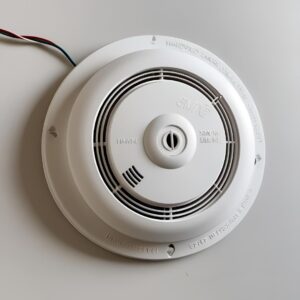
How To Tell If Your Smoke Detector Is Expired
Check the Manufacture Date on the Back of the Unit
Remove the alarm from its mounting bracket and look at the label on the back or side of the unit. Most detectors print the manufacture date directly on the label. Add 10 years to that date – that’s when the unit should be replaced.
If the label is painted over, faded, or missing, you cannot determine the unit’s age. In that case, replace it. An alarm of unknown age has no verified service life remaining. We’ve purchased homes where every detector was original to the construction – some over 20 years old – with owners who had no idea.
Signs a Smoke Detector Has Gone Bad Before 10 Years
Detectors can fail before their 10-year mark. Watch for:
- Persistent chirping after fresh batteries – this often signals internal component failure, not a battery issue
- Yellowed or discolored housing – indicates prolonged environmental exposure that affects sensor performance
- Frequent false alarms – sensitivity drift in aging sensors can trigger false positives before the unit fails entirely
- No response to test button – the most obvious sign; replace immediately
- Physical damage – cracks, visible corrosion, or paint covering the sensor openings
One note on the test button: pressing it confirms the alarm circuit and horn are working. It does not test the sensor’s ability to detect actual smoke particles. A detector can pass the button test and still fail to activate in a real fire.
Do Fire Alarms Expire? What About Hardwired Units?
A common misconception is that hardwired smoke detectors – units wired directly into your home’s electrical system – don’t expire because they have a permanent power source. They do. The 10-year rule applies to all residential smoke alarms regardless of how they’re powered. Even hardwired smoke alarms have backup batteries that need regular replacement, and the units themselves are intended to be replaced after 10 years.
Interconnected hardwired systems – where all alarms trigger together when one detects smoke – are more protective, but the age of each individual unit still matters. An interconnected system with 15-year-old detectors throughout the home is not a well-protected home. We’ve walked through properties where every alarm was hardwired and the owners considered them permanent fixtures. None had been replaced since installation.
Can Smoke Detectors Go Bad Before They Expire?
Yes, and the data confirms it. A joint CPSC, NFPA, and NIST household survey found that nearly one in five households believed all their alarms were working but had at least one functionality issue when actually tested. Homeowners routinely overestimate the reliability of their detectors because the units appear intact and occasionally beep during tests.
Environmental factors accelerate degradation: kitchens with heavy grease exposure, bathrooms with persistent humidity, garages with chemical fumes, and homes with excessive dust all shorten detector service life. In these environments, 8 years is a more conservative replacement target than 10.
Why This Matters More Than People Think
This topic isn’t directly connected to what we do – we buy fire-damaged houses, not smoke detectors. But we include it because we’ve seen what neglected detectors actually cost people. Not in the abstract – in specific homes, specific fires, specific families who had no warning they should have had.
Working smoke alarms reduce the risk of dying in a home fire by more than 60% – yet the majority of civilian home fire deaths still occur in homes with no working alarm. In fires where smoke alarms were present but did not operate, more than two of every five had missing or disconnected batteries. The fires that result in total losses are disproportionately the ones where early warning never came – and in our experience, expired or neglected detectors are far more common than most homeowners assume.
Smoke Detector Expiration Date: The Full Replacement Schedule
| Detector Type | Sensor Lifespan | Replace By |
| Battery-powered smoke alarm | 10 years | 10 years from manufacture date |
| Hardwired smoke alarm | 10 years | 10 years from manufacture date |
| Sealed 10-year battery alarm | 10 years | At end of battery life / 10 years |
| Combination smoke + CO alarm | Smoke: 10 yrs / CO: 5–7 yrs | When CO sensor expires |
| Smart/connected smoke alarm | 10 years | 10 years from manufacture date |
What To Do Right Now
- Pull every detector off the ceiling and check the manufacture date on the back label
- Replace any unit that is 10 years old or older – no exceptions
- Replace any unit with an unknown manufacture date – if you can’t verify the age, assume it’s expired
- Test remaining units monthly using the test button, and replace batteries annually in units without sealed batteries
- Mark your calendar for replacement – write the install date on a piece of tape on the unit so you don’t lose track
If a Fire Has Already Happened
If you’re reading this after a fire, the questions you’re facing are different ones. We’ve worked with enough families in this situation to know how much it matters whether there was a warning or not – the ones who had no alarm, or one that didn’t work, carry that differently. A fire that starts overnight in a back bedroom, a garage fire that spreads before anyone wakes up – the difference between a contained loss and a total one often came down to whether the alarm fired. We’ve purchased properties where the detector was on the ceiling, batteries in, and still didn’t respond.
That’s the part that stays with us. It’s preventable in a way that most fire damage isn’t.
If you’re now navigating what to do with the property, we buy fire-damaged houses in any condition, for cash, with no repairs required. Explore what we do and get a cash offer at no obligation. And if smoke damage is part of what you’re dealing with, how to get smoke smell out is a practical place to start.
Final Thoughts: Do Smoke Alarms Expire?
They do – and the answer has real consequences. A 10-year-old detector that looks and sounds functional may already be unreliable in an actual fire. The fix is simple, inexpensive, and takes 10 minutes: check the date on the back of every unit in your home, and replace anything that’s reached its service life.
The fires we’ve seen that didn’t need to be as devastating as they were have one thing in common more often than any other – no working alarm. This is one of the few fire safety steps where the cost of action is almost nothing, and the cost of inaction can be everything.
Previous