

A backyard fire pit is one of those additions that seems simple until you realize how specific the requirements are and how quickly a poorly placed one can go wrong. In our work buying fire damaged homes, outdoor fires that spread to structures are a consistent and entirely preventable cause of the damage we see. The fires that cause the most damage from backyard fire pits almost always involve one of two things: placement that was too close to the house, or a fire left unattended when conditions changed.
This guide tells you exactly what the regulations require, what the risks are when those requirements are ignored, and what practical steps make a fire pit genuinely safe rather than just technically legal.
What the Regulations Actually Say
There is no single federal rule for fire pit distance. What exists is a framework of national standards that most states and municipalities build on, combined with local codes that can be stricter than the national baseline.
Jurisdictions enforcing NFPA 1 will require that outdoor fires be located not less than 50 feet from any structure. If embers are given off or the fire becomes out of control, the 50-foot requirement provides distance between the fire and surrounding structures. Depending on conditions, the Authority Having Jurisdiction can increase this distance to provide adequate protection.
That 50-foot figure applies to open recreational fires. Fire pits are more contained, and the standard applied to them is different. In general, a recreational fire as defined in NFPA 1 Fire Code should meet the following standards: fuel area no larger than 3 feet in diameter and no more than 2 feet high, and clearance of at least 25 feet from any structure or combustible material. Local regulations can further restrict these distances based on specific local fire safety concerns.
The NFPA recommends a fire pit be positioned at least 10 feet away from any structure or combustible material and advises against using fire pits on wooden decks or under overhanging branches.
The apparent discrepancy between 10 feet and 25 feet reflects two different NFPA documents being applied. The 10-foot figure is a minimum for fire pit use. The 25-foot figure is the standard for recreational fires under NFPA 1. In practice, most fire marshals and local codes use 25 feet as the standard for fire pit placement relative to any structure.
Under NFPA 1 Section 10.11, recreational fires must maintain a 25-foot clearance from structures and combustible materials. An adult must be present and supervising at all times, and a means of extinguishment including a garden hose, fire extinguisher, or bucket of water must be within reach.
Distance by Fire Pit Type
The type of fire pit changes the clearance requirement in practice.
Wood-Burning Fire Pits
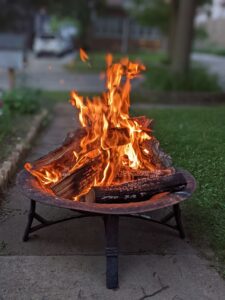
Wood-burning pits produce embers, sparks, and airborne ash that travel significantly further than the visible flame. Wood-burning fire pits produce sparks, smoke, and embers, which means more risk. These require more clearance, staying 15 to 25 feet away from any structure, overhang, or anything flammable. Spark screens or covers are recommended for added protection.
We have seen properties where a wood-burning fire pit placed on a deck ignited the decking boards directly and the fire reached the house structure within minutes. The common thread: placement on or adjacent to a combustible surface, too close to the house, with no one watching when the wind picked up.
Gas Fire Pits
Gas fire pits can typically be placed closer, usually 10 feet from structures depending on the model. They offer cleaner flames with less risk of embers or flare-ups but still need clear overhead space and proper ventilation.
Gas fire pits are regulated by NFPA 54, the National Fuel Gas Code, and NFPA 58 for propane-fueled units. These cover the gas line installation, burner sizing, and ventilation requirements in addition to clearance distance. Gas fire pits and gas fire tables are subject to additional standards for gas system installations and safe operation under NFPA 54 and NFPA 58.
Portable Fire Pits
Portable fire pits should follow the same rules as permanent ones. Their mobility does not change the fire risk if they are placed too close to flammable surfaces. A portable pit placed on a wooden deck three feet from the house is not safer than a permanent pit in the same location. The portability creates a false sense of reduced risk that we have seen translate into damage in practice.
Vertical Clearance: The Measurement Most People Miss
Horizontal distance from the house is what most homeowners focus on. Vertical clearance is equally important and consistently overlooked.
Keep the fire pit away from siding, decks, deck railings, and out from under eaves, overhanging branches, or overhanging rooflines.
Most safety guidelines recommend at least 21 feet of clearance above the fire pit to avoid the risk of igniting overhanging branches, power lines, or patio covers.
An overhanging tree branch at 15 feet above a fire pit that is 25 feet from the house is still a fire hazard. Embers rise and travel on heat columns before falling. A branch that ignites above the fire pit can drop burning material onto the roof, onto the deck, or onto anyone sitting near the fire. Vertical clearance is not a secondary consideration.
What Happens If You Don’t Follow Safety Regulations
The risks of ignoring fire pit placement requirements fall into three categories.
Property Damage and Structural Fire
According to the NFPA, over 5,000 fires per year are linked to improper fire pit placement. A fire pit too close to the house puts siding, deck materials, eaves, and overhanging structures within the reach of radiant heat and airborne embers. Vinyl siding can ignite from radiant heat alone without direct flame contact. Cedar shingles and wood decks are particularly vulnerable to ember landing and smoldering before ignition occurs, sometimes well after the fire pit appears to have burned down.
In our experience, the fires from fire pits that caused the most structural damage were not dramatic instantaneous events. They were embers that landed in leaf-filled gutters or on dry wood decks and smoldered for 30 to 60 minutes before breaking into flame. By that point the source was often well-separated from the fire pit and harder to trace.
Legal and Insurance Consequences
Fire pit regulations are not set at the federal level. They come from a patchwork of state fire codes, county ordinances, city bylaws, and homeowners association rules. What is perfectly legal in a rural Texas backyard might require a permit in suburban Denver or be banned outright on a Los Angeles apartment balcony.
Violating local fire pit codes can result in fines, orders to remove a permanent installation, and in the event of a fire, insurance complications. If a fire starts from a fire pit that was not in compliance with local codes, your homeowner’s insurance provider has grounds to reduce or deny the claim. Compliance documentation, including permits for permanent installations, protects your claim.
Injury Risk
With outdoor fire pits becoming more common, experts warn that the risk of related injuries, especially among children, may continue to rise. A fire pit too close to seating areas, pathways, or the house itself limits the safe zone around the fire and increases the probability of contact injuries from radiant heat, sparks, and stumbling into the fire area.
Other Placement Rules That Matter
Surface. Place the fire pit on even ground or a level surface that will not catch on fire, such as patio blocks, bricks, or concrete. Fire pits should never sit on wooden decks or directly on grass.
Property lines. Fire pits should be at least 10 feet from property lines to minimize the risk of fire spreading to neighboring properties. Some jurisdictions require greater setbacks from property lines than from structures.
Wind. Avoid burning anything outdoors on windy or dry days. Embers from open burning can ignite nearby structures or cause a wildfire even from a small fire. The NFPA is direct on this point. Wind conditions change the effective safe distance of any outdoor fire in ways that a fixed measurement cannot fully account for.
Burn bans. Seasonal burn bans are the most common restriction affecting fire pit owners. These are activated during high fire risk periods such as dry summers in the West and windy fall conditions in many regions, or during poor air quality days. Using a fire pit during an active burn ban carries fine risk and, if a fire results, potentially criminal liability.
Permits: Do You Need One
Local authorities may regulate portable fire pits differently from permanent fire pits. Always check with your local fire department or building department to ensure compliance with local codes.
For permanent wood-burning fire pits and for any gas fire pit requiring a gas line connection, a permit is commonly required. The permit process triggers an inspection that verifies placement, clearance, and installation against local code. Skipping the permit for a permanent installation means the structure is unverified and may create complications at time of home sale.
For portable fire pits, permits are less commonly required but local ordinances vary. A five-minute call to your local fire department clarifies what applies to your property before you invest in a location or installation. Some cities publish their requirements directly. The City of Madison Fire Department notes that a citation may be issued for any violation of their outdoor fire pit ordinance, and that manufacturer instructions must be followed in addition to local code.
What To Keep Near the Fire Pit At All Times
A means of extinguishment including a garden hose, fire extinguisher, or bucket of water must be within reach whenever a recreational fire is in use.
This is a legal requirement under NFPA 1, not a suggestion. For a wood-burning pit, a garden hose with sufficient reach to cover both the fire and any adjacent structure is the most practical option. A bucket of water handles the fire itself. A fire extinguisher handles sparks that have landed elsewhere. Having all three is not excessive.
For guidance on which extinguisher type is appropriate for outdoor fire scenarios, choosing the right fire extinguisher for your home covers size, type, and outdoor placement in detail.
Our Perspective
In our years of buying fire damaged homes, outdoor fire pits that caused structural damage share a consistent profile. A wood-burning pit within 10 feet of a deck or siding. No screen on the pit. Wind conditions that were not present when the fire was first lit. No one watching when things changed. The damage to the properties was not limited to the deck or the exterior wall. It reached interior structural elements and in several cases caused smoke contamination throughout the home that required extensive remediation.
If you want to understand what smoke damage from any fire source does to a home’s indoor air quality, whether it is safe to stay in a house with smoke damage is a practical resource. And if a fire pit fire has already caused damage to your property and the repair cost is beyond what makes sense, what happens when you cannot afford fire repairs covers every realistic option available.
We buy fire damaged homes in any condition, for cash, with no repairs required. Get a free cash offer with no obligation if you want to understand your options before committing to a repair budget.
Final Thoughts
The minimum safe distance for a fire pit from your house is 25 feet under NFPA 1, with 10 feet as the absolute floor for contained pit fires and 50 feet applying to open recreational fires. Wood-burning pits require greater clearance than gas pits. Vertical clearance of at least 21 feet above the fire must be maintained. The surface must be non-combustible. And someone must be present, watching, with extinguishing equipment within reach, whenever the fire is burning.
This Old House’s fire pit safety guide covers both clearance and surface requirements in practical terms that apply directly to most residential backyard setups.
These are not arbitrary numbers. They reflect decades of fire incident data and engineering analysis of how fires spread from outdoor sources to structures. Following them protects your property. Ignoring them creates a risk that has already materialized for thousands of homeowners every year.
Previous