

House fires aren’t rare events that happen to other people. They happen constantly, across every state, in every type of home, to people who never expected it. If you’ve ever wondered how common house fires actually are – the numbers are more sobering than most people realize.
How Many House Fires Per Year Happen in the US?
In 2024, an estimated 329,500 home structure fires were reported in the United States – roughly one every 96 seconds. That’s not total fires including commercial and outdoor incidents. That’s residential homes, specifically.
Those fires caused approximately 3,920 civilian deaths in 2024 – a figure that is 37% higher than the record low recorded in 2012, and up 6.8% from 2023. Despite decades of improvements in building codes, smoke detector adoption, and fire safety awareness, the death toll is trending in the wrong direction.
The property damage picture is equally stark. Home structure fires caused an estimated $11.4 billion in direct property damage in 2024. That figure doesn’t include temporary housing costs, lost contents, or the long-term financial impact on families who are underinsured or uninsured.
We’ve seen that financial reality up close. The gap between what insurance covers and what it actually costs to recover is one of the most consistent themes in our work with fire-affected homeowners.
Most Common House Fire Causes
Understanding where fires come from matters – not for trivia, but because most of the leading causes are entirely preventable.
Cooking
Cooking is the leading cause of home fires in the United States, responsible for an estimated 158,400 home fires per year. Unattended equipment is a factor in 29% of home cooking fires, and 53% involve a stovetop or range.
Kitchens are where we see the most frequent origin points in the properties we’ve worked with – a pan left on the stove, grease that built up over months on a range hood, a dish towel placed too close to an open burner. The fires that start this way are often small and fast. In the right conditions, a kitchen fire reaches the ceiling in under a minute. If you want to understand which everyday items accelerate that process, highly flammable household items covers the ones most people wouldn’t think twice about.
Heating Equipment
Portable heater fires accounted for 41% of fatal heating fires in residential buildings, despite representing only 3% of all heating fires – making them disproportionately deadly relative to their frequency.
Space heaters placed near clothing, bedding, or curtains. Furnaces that haven’t been serviced in years. Fireplaces with blocked or dirty chimneys. These are the heating-related fires we encounter most in the properties we buy – and they tend to happen at night, when occupants are asleep and detection comes late.
Electrical Fires
Electrical distribution and lighting equipment caused an average of 30,740 fires annually, including fires started by dryers, heating equipment, and air conditioners.
Electrical fires are particularly dangerous because they often start inside walls, where they’re invisible and burn for a significant amount of time before breaking through a surface. By the time smoke is visible, the fire has usually already compromised structural elements. We’ve walked through homes where the electrical panel was the clear origin point – and the damage extended through three floors of wall cavities before anyone knew something was wrong.
If you’re seeing warning signs in your home – flickering lights, frequently tripping breakers, outlets that feel warm – signs your house is in danger of an electrical fire covers exactly what to watch for before it becomes an emergency.
Dryers are a specific electrical risk worth calling out separately. They’re responsible for thousands of residential fires every year, almost always from lint accumulation that most homeowners never think to address. What causes dryer fires and how to prevent them is a straightforward read that takes the guesswork out of one of the most preventable fire risks in any home.
Smoking Materials
Fires caused by smoking materials resulted in an average of 620 deaths per year from 2016 to 2020, making them among the deadliest categories despite causing fewer total fires than cooking. Cigarettes dropped on upholstered furniture or in bedding create slow smoldering fires that produce significant smoke before open flame – exactly the scenario where a working smoke detector is the difference between waking up in time and not waking up at all.
Intentional Fires
From 2016 to 2020, around 29,400 house fires – approximately 9% – in the US were intentionally caused, resulting in an average of 360 deaths and 820 injuries per year. This is a category most homeowners don’t think about when considering fire risk, but it represents a consistent and significant share of residential fire incidents.
When House Fires Are Most Likely To Happen
The timing of fires matters for understanding risk and for making sure your detection and prevention systems are in place when they’re most needed.
46% of home structure fires happened between November and March, and 55% of home fire deaths occurred in those same months. Heating equipment use increases, people spend more time indoors, and holiday decorations add ignition risk throughout the winter season.
The most common time window for house fires is between 4:00 and 9:00 PM – but fires that occur between 11 PM and 7 AM, while far less frequent, account for nearly half of all home fire deaths. Nighttime fires are deadlier because occupants are asleep, detection comes later, and escape time is reduced. This is the statistical case for having working smoke detectors inside every bedroom – not just in hallways.
What These Numbers Look Like in Practice
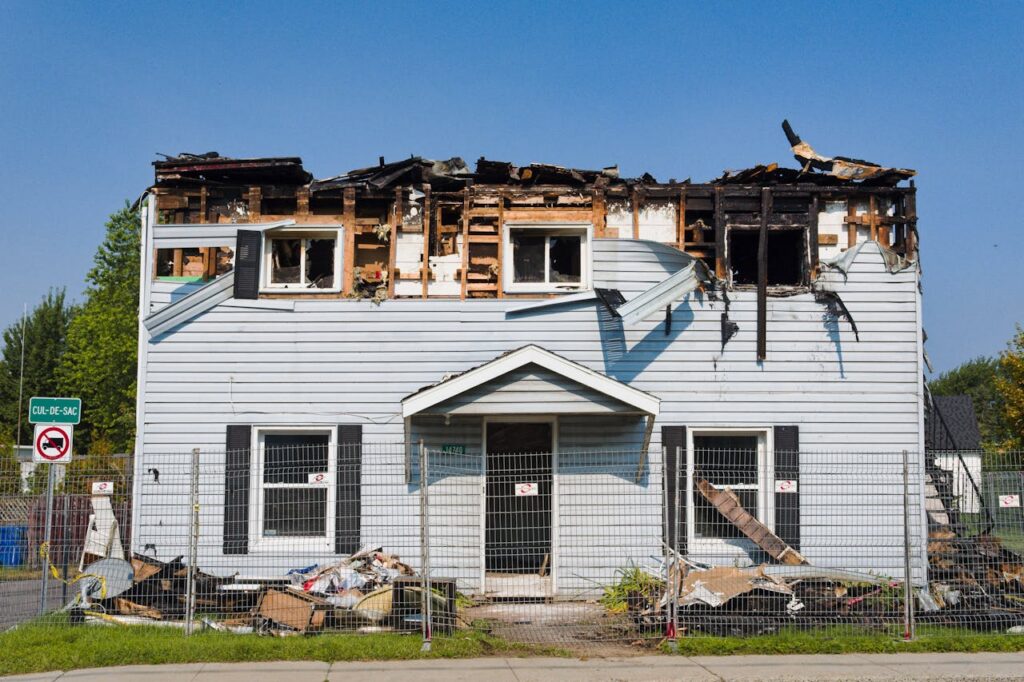
Statistics describe scale. They don’t describe what a house fire actually does to a family or a property. In our years of buying fire-damaged homes, the numbers above translate into specific, recurring patterns.
The fires that result in total losses are almost never dramatic explosions or sudden infernos. They’re cooking fires that weren’t caught in the first 30 seconds. They’re electrical fires that burned inside a wall for an hour before breaking through. They’re heating fires that started in a basement while the family was asleep two floors up. The damage is severe not because the fire was unusually intense, but because something – a missing detector, a closed door, a delayed call – gave it more time than it needed.
The fires that resulted in partial damage and successful recovery almost always had one thing in common: early detection and fast response. A detector that went off before the fire left the room of origin. An occupant who was awake and had an extinguisher accessible. A neighbor who called 911 while the fire was still contained.
Where most house fires start breaks down the room-by-room data in detail – useful context for understanding which areas of your home carry the most risk and where to focus prevention efforts.
What You Can Do With This Information
House fire statistics aren’t just data points – they’re a map of where prevention efforts have the highest return.
Cooking fires are the most common, but they’re also the most interruptible. Stay in the kitchen when something is on the stove. Keep flammable items off the counter near the range. Know where your extinguisher is and whether it’s accessible.
Electrical fires are the most invisible risk. If your home is older, having the wiring inspected is not an overcautious move – it’s a direct response to one of the leading causes of residential fire fatalities.
If you’ve recently gone through a fire and are thinking about rebuilding, choosing fire-resistant materials is a practical guide to making construction decisions that give your next home a meaningfully better chance of surviving what the statistics say is an always-present risk.
And if you’re in the position where the fire has already happened and you’re trying to figure out what comes next – we buy fire-damaged houses in any condition, for cash, with no repairs required. The decision to rebuild or sell is significant and worth making with full information. We can give you a cash offer with no obligation so you have real numbers to work with before you commit to anything.
Final Thoughts on House Fire Statistics
A home fire is reported every 96 seconds in the United States. Most of those fires were preventable. Most of the deaths were preventable. The gap between a fire that destroys a home and a fire that gets put out before it leaves the kitchen is almost always a matter of preparation – not luck.
The statistics don’t change what happened if you’ve already been through a fire. But they do clarify that this is not a rare or random event. It’s a common, predictable risk – and one that responds directly to the decisions homeowners make before a fire ever starts.
Previous